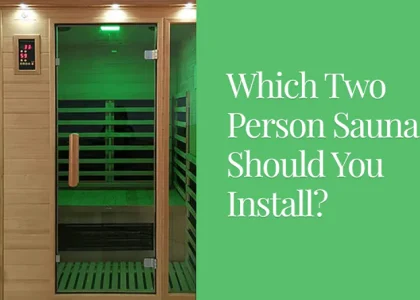


If you are thinking about installing a four person sauna in your home, you have a number of different options involving more than just size. A sauna that holds multiple people is a significant investment, naturally taking up space and requiring specific utility adjustments. You want to be certain you are making the best choice for your needs, factoring in the required space, electrical/ventilation requirements, user experience, and health benefits.
This guide breaks down the two primary types of four-person saunas available for home installation: Traditional (Conventional) and Infrared.
1. Traditional / Conventional Saunas
Traditional saunas heat the air using a heater unit, which then warms the occupants. They are defined by the high heat and humidity they produce, creating the classic “sauna experience.”
Core Sub-Types and Requirements
| Type | Heating Mechanism | Temperature Range | Humidity Control |
|---|---|---|---|
| Wood Burning | Stove with natural wood; rocks placed on top. | Up to 220∘F (104∘C) | High (by splashing water on rocks). |
| Electric (Dry) | Heating elements warm volcanic rocks. | 180∘F – 200∘F | Low (No water splashed). |
| Electric (Wet/Steam) | Heating elements warm rocks; water is splashed to create steam. | 160∘F – 185∘F | Moderate to High. |
Practical Considerations for a 4-Person Traditional Unit
- Ventilation is Mandatory: For wood-burning saunas, proper chimney or flue ventilation to the outside is non-negotiable for safety. Electric units also require carefully planned ceiling and wall vents for fresh air intake and circulation, but do not need exterior venting for smoke.
- Dedicated Power Circuit: A 4-person electric sauna typically requires a 240-volt, 40- to 50-amp dedicated breaker circuit. This is a major electrical modification and must be performed by a licensed electrician.
- Installation & Placement: Due to the intense heat and potential steam, traditional saunas must be built with moisture-resistant and high-temperature-tolerant materials and placed on a surface that can handle potential water spillage. They often require more complex construction than infrared models.
Experience Tip: If you enjoy the sensation of high heat and steam that clears your airways, a traditional wet sauna offers an intense and deeply rooted cultural experience.
2. Infrared Saunas (Far, Mid, and Near)
Infrared saunas are fundamentally different. They use electromagnetic emitters (typically ceramic or carbon fiber panels) to emit specific wavelengths of light that your body absorbs, heating your body directly from the inside out without drastically raising the ambient air temperature.
Technology and Performance
- Heating Panels:
- Ceramic Emitters: Heat up very quickly and achieve high intensity, but often have smaller surface areas.
- Carbon Fiber Emitters: Provide a lower, more consistent surface temperature and cover a much larger area, resulting in a more even distribution of heat waves across the body. Carbon fiber is generally preferred for large home units.
- Wavelengths for Targeted Benefits:
- Far Infrared (FIR): This is the most common and longest wavelength. It is primarily responsible for raising the core body temperature and inducing heavy sweating, leading to detoxification and cardiovascular benefits.
- Mid Infrared: Penetrates deeper into soft tissue, aiding in pain management and muscle recovery.
- Near Infrared (NIR): The shortest wavelength, used primarily for topical benefits like skin health, wound healing, and cellular regeneration.
Practical Considerations for a 4-Person Infrared Unit
- Electrical Simplicity: Many 4-person infrared units can operate on a standard 120-volt household outlet, although a dedicated 20-amp circuit is often recommended to prevent tripping breakers, especially if the unit has a high emitter count. This avoids the costly 240V wiring required for traditional electric units.
- Low Maintenance: Since there are no rocks or water involved, maintenance is simpler, primarily involving wiping down the benches and floor.
- Ease of Installation: Infrared saunas often arrive as pre-fabricated panels that lock together, making them significantly easier to install and even dismantle and move if you change homes.
Experience Tip: Infrared saunas provide a gentler, more relaxing heat (120∘F – 150∘F) that allows for longer sessions, making it ideal for therapeutic goals like deep relaxation and improved sleep.
Comparative Breakdown: Traditional vs. Infrared
| Feature | Traditional Electric Sauna | Infrared Sauna | Verdict for Home Use |
|---|---|---|---|
| Installation Complexity | High (Requires 240V dedicated wiring, extensive insulation, and ventilation). | Low (Often 120V plug-and-play and panel assembly). | Infrared (Easier and lower upfront cost). |
| Energy Consumption | High (Needs to heat a large volume of air to high temperatures). | Low (Heats the body directly; more efficient). | Infrared (Lower operating costs over time). |
| Toxin Removal | Good (Primary sweat release). | Excellent (Deeper tissue penetration for heavy metals and deep-stored toxins). | Infrared (Superior depth of effect). |
| Warm-Up Time | 30 to 45 minutes to reach peak temperature. | 10 to 20 minutes to reach therapeutic heat. | Infrared (Faster access to benefits). |
| Air Quality | Can feel heavy or stifling due to high temperature and humidity. | Comfortable and breathable due to lower ambient air temperature. | Infrared (More enjoyable for prolonged sessions). |
Actionable Tips for Choosing Your 4-Person Sauna
- Measure Your Space (Twice): A 4-person unit requires a minimum of 5ft×5ft of floor space, but often more. Account for exterior dimensions and ensure you have at least 1−2 inches of clearance around the top and sides for air flow.
- Evaluate Bench Comfort: Since a 4-person unit is designed for socializing or lying down, check the bench width and length. Look for multi-level benches if you choose traditional, as heat rises.
- Confirm the Wood: Always choose high-quality, non-toxic wood. Cedar is the classic choice for its aroma and resistance to moisture, but Hemlock is a popular, non-aromatic, and cost-effective choice for infrared units.
- Prioritize Emitter Quality (Infrared): If choosing infrared, the number and surface area of the carbon fiber emitters directly correlate to the quality of the session. Ensure the emitters cover the walls, floor, and even the calf area for full-body coverage.
- Review Warranty: Due to the intense heat and electrical components, choose a brand that offers a solid 5- to 7-year warranty on the heater/emitters and structural cabin.
By carefully considering the installation requirements and your personal health goals, you can select the perfect 4-person sauna that serves as a relaxing and beneficial retreat for years to come.